Cannabis Pathology · Trichome Science · 2026 Research
Cannabis Bud Rot: The Rot You Don’t See Until It’s Too Late
Bud rot doesn't just destroy yield. A 2026 preprint from India documents what Botrytis cinerea actually does inside your flower — collapsing trichome structure, wiping out CBD, and rewriting the plant's cannabinoid chemistry from the inside out.
- −91% CBD collapse in field-infected plants (1.87% to 0.16%)
- +117% THC increase in infected plants (1.04% to 2.25%)
- 20°C / 94%RH The peak trigger conditions for Botrytis spore production
- 7 days Time required for complete bud colonisation in high humidity
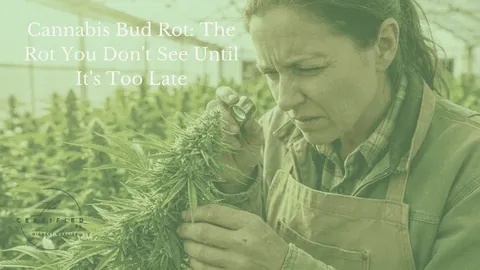
Most cannabis growers who have dealt with bud rot (Botrytis cinerea) describe the same devastating experience. You're a week or two from harvest. The flowers look dense, healthy, and frosted with trichomes. Then you find it — a patch of grey-brown fuzz buried inside a cola, or a single bract that crumbles when you touch it. By the time grey mould is visible on the surface, it has already been inside the flower for days, possibly weeks. The damage is done.
What that damage actually looks like — chemically, structurally, at the level of the trichomes themselves — has never been fully documented. Growers have known for years that infected buds smell wrong, smoke harsh, and test lower for potency. But the precise mechanism, and the specific changes to the cannabinoid and terpene profile that infection causes, had not been studied in a controlled scientific setting. Until now.
A preprint posted to Research Square in February 2026 by researchers at CSIR-Central Institute of Medicinal and Aromatic Plants in Lucknow, India, reports the first characterisation of Botrytis cinerea infecting cannabis. More importantly, it provides the first direct measurement of what that infection does to trichome structure, cannabinoid content, and terpene profiles. The findings are unsettling, and directly relevant to anyone growing CBD-dominant or medicinal cannabis.
What is Botrytis Cinerea (Bud Rot) in Cannabis?
Botrytis cinerea is the causal agent of grey mould, universally known to cultivators as cannabis bud rot. It is a necrotrophic fungal pathogen, meaning it actively kills the host tissue it colonises rather than living within it subtly. Ranked the second most economically damaging fungal pathogen globally, it attacks over 200 plant species. Cannabis is not a special case; it is simply another highly vulnerable host.
The pathogen enters cannabis inflorescences primarily through airborne conidia — microscopic spores that are always present in the environment, whether in outdoor field conditions, indoor grow tents, greenhouses, or post-harvest drying spaces. What makes cannabis particularly susceptible is the nature of late-stage flowers: dense, moisture-retaining, and covered in glandular trichomes that the fungus exploits as entry points and nutrient sources.
What Causes Bud Rot? The Ideal Conditions for Botrytis Spores
To effectively prevent bud rot, cultivators need to understand environmental triggers. The Indian research team mapped the exact environmental conditions under which B. cinerea produces the most spores on cannabis inflorescences. This matters because spore load drives infection pressure — the more conidia in the air, the faster an outbreak spreads through your canopy.
The practical takeaway: if your late-flower environment sits between 15°C and 25°C with a relative humidity above 85%, you are running conditions that maximise Botrytis infection success. The dense, tightly packed colas that yield the most weight are the exact structures that trap moisture and create these dangerous micro-climates.
Trichome Damage: How Botrytis Destroys Cannabis Resin
This is where the research breaks genuinely new ground. Using scanning electron microscopy, the team visualised the interaction between B. cinerea and the trichome structures of infected cannabis tissue. What they found describes a systematic dismantling of the very biological factories responsible for cannabinoid and terpene production.
Cannabis flowers carry three types of trichomes, but the capitate-stalked trichomes — the large, mushroom-shaped glands that produce the bulk of the plant's resin — were the most severely affected. Under the electron microscope, infected tissue showed:
-
Surface Colonisation
Extensive mycelial growth blankets the bud surface, with spore-bearing stalks growing directly from the bract tissue. The fungal mass physically displaces and crushes delicate trichomes.
-
Deep Vascular Invasion
The pathogen is not confined to the surface. Mycelial filaments penetrate deep into the central vascular core (xylem and phloem). This is a systemic tissue infection, not mere surface mould.
-
Trichome Deformation
Glandular trichomes are visibly disrupted and trapped within mycelium. The characteristic round secretory heads — which contain the valuable oils — are completely collapsed or missing.
-
Density Reduction
Trichome density on infected bract tissue is markedly lower than on healthy tissue. Fungal colonisation actively reduces the number of functional trichomes left on the plant.
The researchers propose a two-fold mechanism of destruction: direct physical crushing of trichomes by fungal growth, and indirect disruption of biosynthesis pathways. The plant essentially reprograms its own chemistry in a failed attempt to fight off the infection.
The pathogen colonises the very factory that produces the plant's most valuable compounds — and the disruption is not subtle. It is a comprehensive dismantling of trichome integrity.
Cannabinoid Changes: Bud Rot Drops CBD and Increases THC
The High-Performance Liquid Chromatography (HPLC) chemical analysis is where the data becomes alarming for anyone producing medicinal hemp or CBD-dominant cannabis. The numbers reveal a dramatic, consistent chemical transformation inside the rotting bud.
This directional shift is not a coincidence. Both CBD and THC share the same biosynthetic precursor pathway (CBGA) within the glandular trichomes. The researchers suggest the fungal infection interferes with the enzymatic steps controlling this pathway, driven by oxidative stress and the pathogen's toxic secondary metabolites (botrydial and botcinic acid).
Terpene Loss: How Grey Mould Destroys Cannabis Aromas
Gas Chromatography (GC-MS) analysis completes the picture of what cannabis bud rot truly costs. Measuring thirteen significant terpene compounds, researchers confirmed that the loss of structural trichomes directly correlates to a massive loss of therapeutic aromas.
Non-infected plants presented a classic therapeutic profile: high Limonene, significant Myrcene, and strong β-Caryophyllene. Infected plants presented a distorted, hollowed-out version of this profile, stripping the flower of its medicinal value and bag appeal.
How to Prevent and Manage Cannabis Bud Rot
While this study focused on pathology, the data provides a clear roadmap for cultivators looking to prevent bud rot and protect their canopy.
Frequently Asked Questions About Cannabis Bud Rot
Can you smoke weed with bud rot?
No. Smoking cannabis infected with Botrytis cinerea (bud rot) is highly dangerous. The mould spores can cause severe respiratory infections, allergic reactions, and potentially introduce harmful mycotoxins into your lungs. Any infected plant material should be carefully bagged and discarded.
Can you save buds that have bud rot?
You cannot "cure" or save a bud once it has begun rotting. The visible grey mould is just the fruiting body; the mycelial network has already invaded deep into the vascular tissue of the flower. You must carefully cut away the infected cola, plus at least two inches of seemingly healthy tissue below it, to stop the spread.
Does bud rot spread while drying or in the curing jar?
Yes. Botrytis spores remain active after harvest. If your drying room humidity spikes above 60%, or if buds are placed into curing jars while still too wet, the latent mould spores will germinate and destroy the harvest inside the jar.
Sources
- Yadav SS, Aftab N, Kumar B. Botrytis cinerea infection modulates trichome development and secondary metabolite biosynthesis in Cannabis sativa . Preprint posted February 6, 2026. doi:10.21203/rs.3.rs-8682864/v1 — CSIR-Central Institute of Medicinal and Aromatic Plants, Lucknow, India. This article is a preprint and has not yet completed peer review. https://doi.org/10.21203/rs.3.rs-8682864/v1